Most biodiversity surveys capture a single moment in time.
A trap is deployed, insects are collected, and researchers draw conclusions from what happened during a determined moment in time. While this approach has been the standard for decades, it inevitably leaves gaps. The weather changes, different species emerge at varied times, and management practices create effects that unfold over weeks.
What changes when biodiversity is monitored continuously instead?
New research presented at the 22nd International Conference on Organic Fruit-Growing provides a compelling answer. Across two growing seasons in organic and conventional orchards, researchers showed how continuous monitoring reveals ecological patterns that traditional sampling methods can easily overlook.
A Two-Season Comparison of Organic and Conventional Orchards
Researchers from Poland's National Institute of Horticultural Research monitored insect activity across multiple agricultural sites over two consecutive growing seasons.
The study included:
- Organic and conventional apple orchards in central Poland
- Organic and conventional raspberry plantations in eastern Poland
- A nearby garden that served as a natural reference site
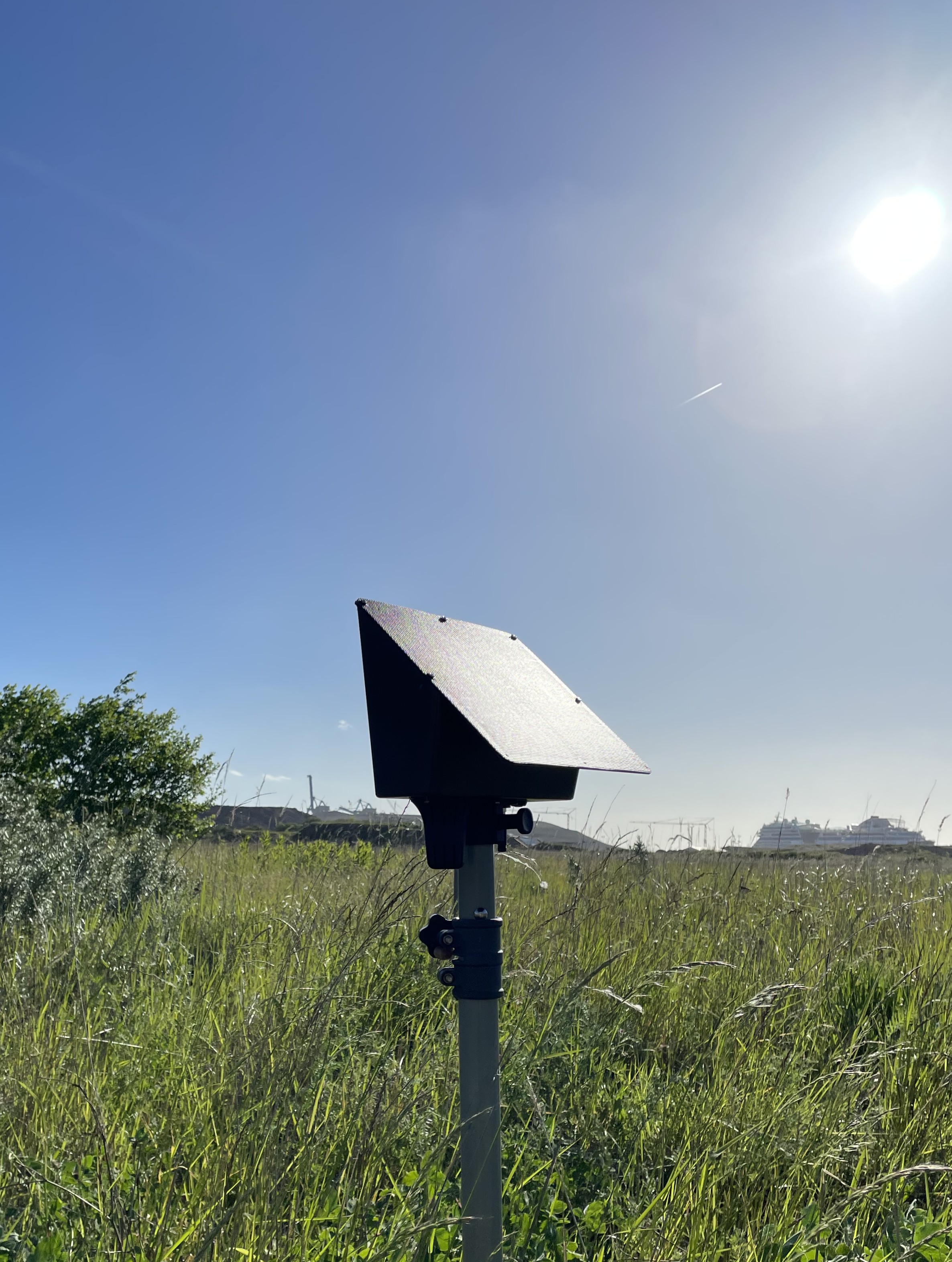
Rather than relying on manual trapping, each site was equipped with evo-sense sensors that operated every day throughout the season. Powered by solar energy, the sensors activated one hour before sunrise and continued until one hour after sunset, continuously recording flying insect activity without trapping or disturbing insects.
Monitoring Without Traps
The evolito monitoring system detects insects using electrostatic field sensing, recording each insect's wingbeat frequency as it flies near the sensor.
Evolito’s cloud and model using AI and ML then converts these signals into key biodiversity metrics, including insect abundance, diversity, biomass, activity and Uplift over time.
As the measurements were collected automatically throughout the entire season, researchers could compare trends across sites without the labour-intensive work of collecting, sorting, and identifying trap samples.
More importantly, they could observe ecological dynamics as they happened.
What the Study Found
The results demonstrated that abundance and diversity do not necessarily move together.
Apple orchards
Across the apple sites:
- Species diversity remained relatively consistent.
- The reference garden recorded the highest insect abundance.
- Both organic and conventional orchards showed lower overall abundance.
- The organic orchard, however, maintained diversity levels comparable to the reference garden while outperforming the conventional orchard.
Raspberry plantations
The raspberry sites showed a similar pattern.
Species diversity remained broadly stable across management types, while one of the organic plantations recorded higher insect abundance than its conventional counterpart.
Taken together, the findings reinforce an important ecological principle: more insects do not automatically mean higher biodiversity.
Abundance and diversity provide different information, and both are needed to understand ecosystem health. That’s why our Uplift metric shows the combination of both metrics over time.
Why Continuous Monitoring Matters
These insights were only possible because researchers monitored the same locations continuously across two full growing seasons.
A single trapping event could easily have missed temporary fluctuations caused by weather, flowering periods, or farm management activities. Continuous monitoring instead revealed how insect communities changed throughout the season, providing a far more representative picture of biodiversity.
Better Data for Better Decisions
Insects are among the fastest biological indicators of environmental change.
They respond quickly to habitat management, restoration activities, pesticide use, flowering resources, and seasonal variation. Capturing those responses requires consistent observation rather than occasional sampling.
For growers, food companies, and land managers, this creates an opportunity to measure the real ecological outcomes of management decisions instead of relying on assumptions.
As biodiversity increasingly becomes part of sustainability strategies and supply chain commitments, continuous monitoring offers a practical way to generate objective, repeatable evidence of ecological change.
Reference
Tartanus, M., Podedworny, G., El Meziane, A., & Malusà, E. (2026). A new approach to estimate arthropods biodiversity in orchards. Proceedings of the 22nd International Conference on Organic Fruit-Growing, Filderstadt, Germany, 23-25 February 2026. FOEKO e.V., pp. 92-95.


.jpg)